Razer's Huntsman V3 Pro Mini crams 8,000Hz into a 60% board
Razer has put true 8,000 Hz polling and its full Advanced Input Control suite into a compact 60% analogue optical keyboard aimed at esports players.
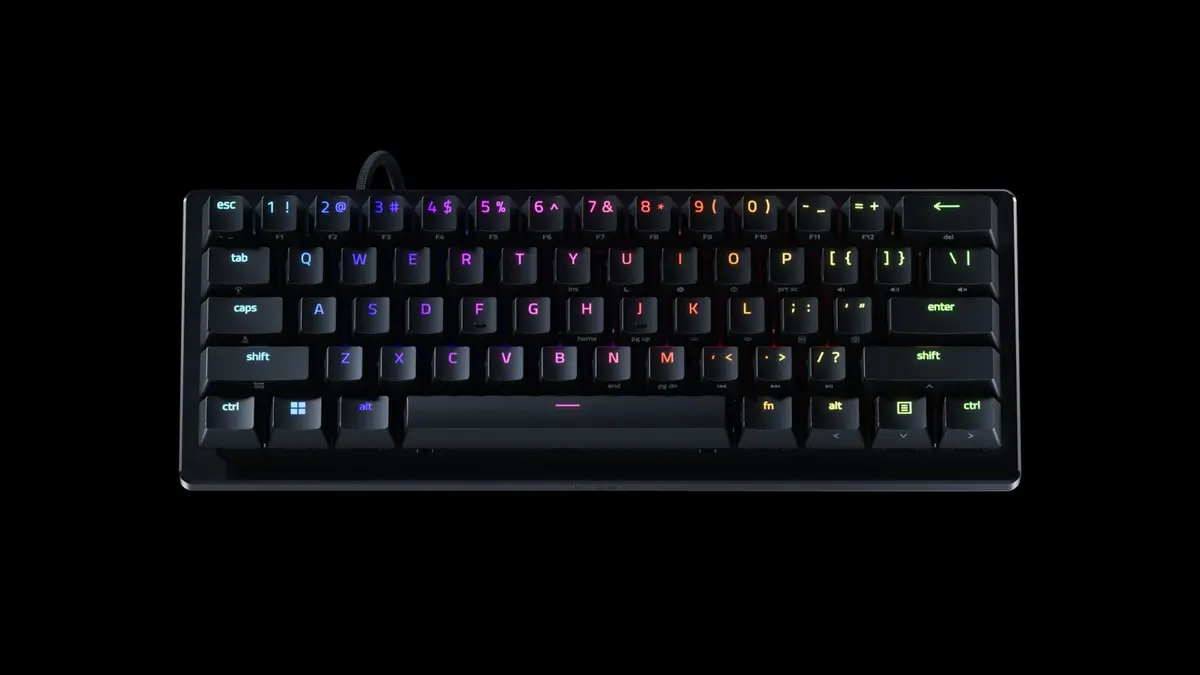
Razer has announced the Huntsman V3 Pro Mini 8KHz, a 60% analogue optical keyboard that takes the headline features of its full-size Huntsman V3 Pro line and shrinks them into a board built for mouse room and a rucksack. The company announced the keyboard on 1 October 2026.
It is the newest member of the Huntsman V3 Pro family and, on Razer's own framing, the most advanced analogue optical keyboard you can buy in a 60% layout.
What the 8KHz badge actually buys
The headline change is true 8,000 Hz HyperPolling, which is eight times the 1,000 Hz report rate that most gaming keyboards still run at. Razer says the board averages 0.48 ms of latency, which it puts at 26% faster than the nearest competitor in its own internal testing. Treat vendor latency numbers with the usual caution, but the direction of travel is not in doubt: peripherals are being sold on milliseconds.
The switches do the heavy lifting
The Mini 8KHz is built on Razer's Analog Optical Switches Gen-2, which support Rapid Trigger for ultra-fast repeated inputs and an adjustable actuation range of 0.1 mm to 4.0 mm. Razer rates each switch for a 100-million keystroke lifespan and says every switch is individually lubricated and seated on a foam dampening layer for a smoother, quieter feel.
Razer also claims roughly 2.5x better actuation-point precision than the closest competing board in its tests. The company is careful to say that supporting evidence is its own, so the numbers are a manufacturer's benchmark rather than an independent one.
A small board with pro-grade controls
The compact case does not mean a stripped feature set. The full Advanced Input Control suite is here: Snap Flex, Snap Tap, Dynamic Keystroke and Dual-Keypress Priority, the tools Razer pitches at players who want to tune how a keypress behaves rather than just how fast it registers.
Players can adjust actuation height and Rapid Trigger sensitivity from the number row, saving up to six profiles to onboard storage without installing software, and Razer's browser-based Synapse Web is supported too. The board uses a 5052 aluminium alloy top case, doubleshot PBT keycaps, and dual-purpose modifier keys that double as 4-way arrow keys when tapped.
Our opinion
Razer is selling a very specific idea here: that the last competitive edge left in a keyboard is measured in fractions of a millisecond, and that shrinking the board should not cost you the tuning tools. For a tournament player who has already maxed out everything else, that is a coherent pitch. For the rest of us, 8,000 Hz is the new 4K on a phone screen, a number that sounds decisive in a spec sheet and is very hard to feel. The genuinely useful part is unglamorous: onboard profiles, browser-based setup and an aluminium case most people will never wear out. Razer's real challenge is that it now sells this performance at three different prices, and the gap between a Huntsman V3 Pro and this Mini is measured in features only a pro will notice.