Valve puts Steam Deck framerate data in developers' hands
Valve has added framerate distribution data to the Steamworks partner dashboard, giving developers a clearer view of how their games run on Steam Deck.
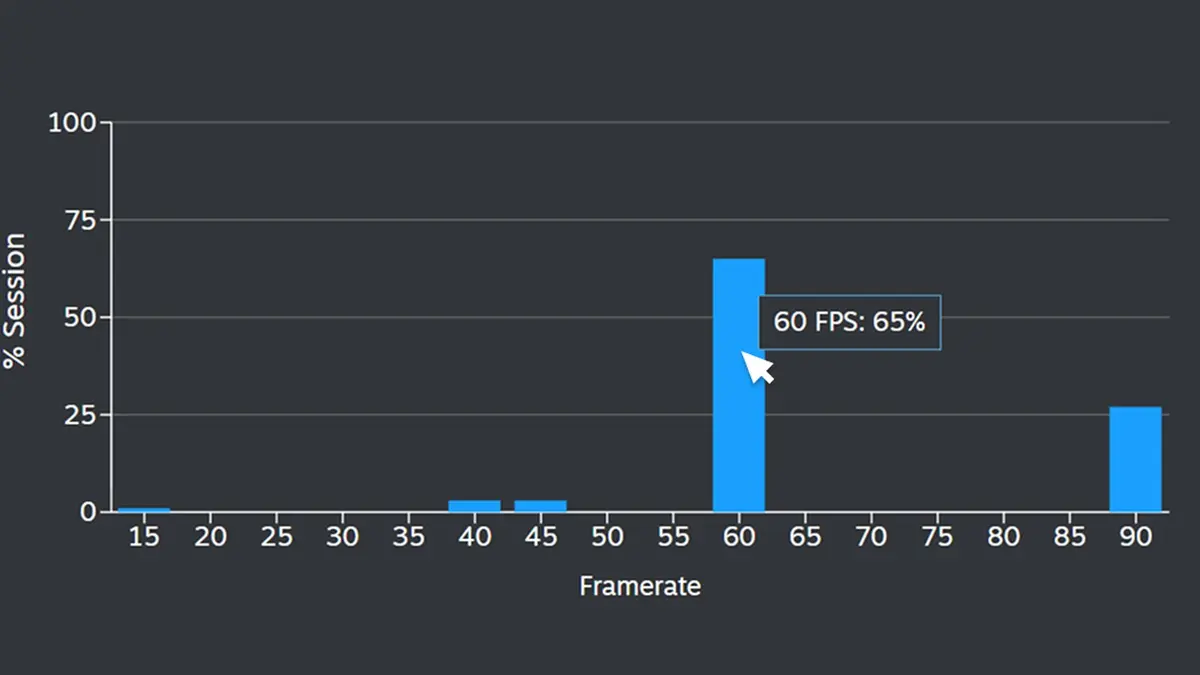
Valve has updated the Steamworks partner dashboard with far more detail about how games actually run on Steam Deck, turning a single average into a picture of what players are experiencing. The change was published on 1 October 2026.
The new data is available to titles that are Steam Deck Verified. Developers reach it from their partner landing page under Technical Tools, then Steam Hardware Compatibility Review.
What developers can now see
The headline addition is a framerate distribution chart. Rather than one average figure, it spreads the sessions sampled from Steam Deck owners who have opted in to sharing framerate data across the range of frame rates those sessions actually ran at. Valve says the distribution sits alongside the average framerate and customer feedback charts the dashboard already carried.
Read together, the three views are meant to answer a question an average cannot: not simply how fast a game runs on Deck, but how often it holds that speed, and how often it falls apart.
Reading the numbers honestly
Valve has included a short list of caveats, and they matter. A Steam Deck LCD tops out at 60 FPS and a Steam Deck OLED at 90 FPS. Players can cap the frame rate themselves to save battery, so a game that can hold 90 FPS will still log plenty of sessions at lower rates. Some players dock the handheld to an external display with a higher refresh rate. The data also counts every sampled moment, including loading screens, where the frame rate can drop sharply.
In other words, a low reading is not automatically a verdict on a game's optimisation. It is a prompt to look at the shape of the distribution, and at what players are reporting alongside it.
Where the data comes from
The figures come from Steam Deck owners who have opted in to sharing anonymised framerate data. Valve says a majority of Deck players have opted in, covering a wide range of games and play styles. It has started with Steam Deck specifically because every unit has the same hardware configuration, which makes comparisons meaningful in a way they are not across a mixed population of gaming PCs.
Valve's suggested use case is concrete. If a large share of a game's sessions land below 30 FPS while players report performance and stability problems, that is a reasonable signal to look at optimisation or to change the default graphics configuration on Deck.
Our opinion
The interesting thing about this release is that Valve is handing developers data that can embarrass them, and inviting them to use it. A distribution chart is much harder to argue with than an average, because the players who are quietly suffering through drops and stutters are exactly the ones an average hides. It also nudges studios towards thinking about Deck as a fixed target rather than a curiosity: one device, one spec sheet, and no excuse about which GPU driver went wrong. The caveats are just as useful, because they stop the chart being misread as a league table. What this does not do is make Deck a certification you pass once. It makes performance a running conversation, and that is a much better product.