Scritchy Scratchy passes 1.5 million sales on its way to Switch 2
Lunch Money Games and Funday Games explain how a scratch card hit sold 1.5 million copies while a single Unity project carried it to mobile and Nintendo's consoles.
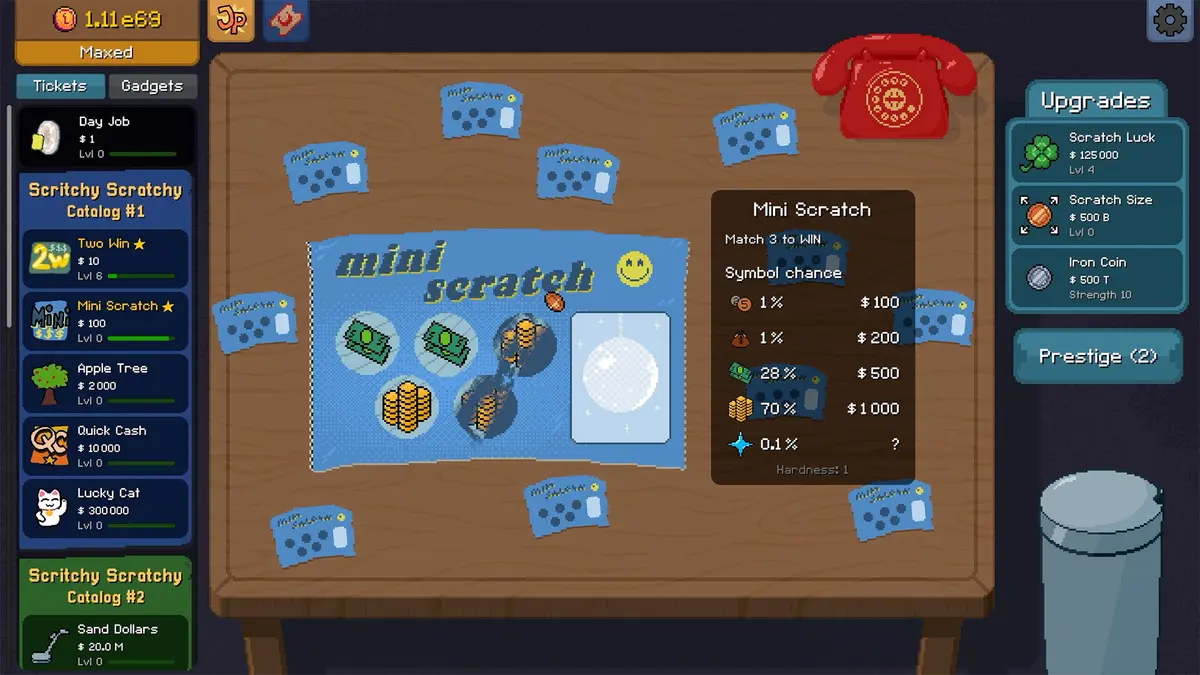
Scritchy Scratchy has sold more than 1.5 million copies. Unity revealed the total on 28 September in a porting case study that breaks down how Lunch Money Games took a mouse-and-touch scratch card game to mobile and Nintendo's consoles without splitting its codebase.
One project instead of four branches
The numbers behind the port are the kind most independent studios would take: more than 1.25 million units sold on Steam and 250,000 on mobile, with a 94% positive Steam rating across more than 14,000 reviews. Lunch Money Games developed the game, with Funday Games handling the mobile and Nintendo Switch versions and listed as publisher on the Steam store page.
Rather than running a long-lived branch per platform, the team kept a single Unity project. Christian Biskopsto Thomsen, a programmer working with Funday Games on the ports, told Unity that separate branches drift: a fix on one has to be integrated into the others, and that becomes tedious once four or more targets are in play. A single project has its own cost in conditional compilation and platform checks scattered through the code, but for a game of this scale the trade was manageable. Creative director Constantin Lervig added that the arrangement means every optimisation and bug fix lands across every build at once.
Scratching, but with a controller
Scritchy Scratchy is built around scratching a card, an interaction that mapped almost immediately to touch and mouse. Gamepads were the difficult case. Instead of mapping a cursor one-to-one, the team rebuilt the mechanic: input snaps toward the relevant area when a ticket is opened, so the player scratches where it matters rather than dragging a pointer around. Funday Games head of product Emil Kjaehr described a workshop where four people took the PC interaction apart and rebuilt it as a wireframe for the other platforms.
On Nintendo Switch 2 the team also wanted to support the console's mouse functionality, and on mobile they added haptic feedback while scratching. Haptics behave differently across the Android hardware range, and Kjaehr said users reported phones vibrating far too strongly, which took several iterations to settle.
Profiling before guessing
Performance work followed the same discipline. The scratch effect reads colour from the ticket texture and generates matching particles, which was fine on PC and too heavy on mobile. Switching those particles to GPU instancing became, in the team's account, one of the most important optimisations in the port. The stated goal across platforms was a seamless 60 fps with control schemes that carry over through Unity's input system.
Our opinion
The most interesting detail in this case study is not the sales figure, generous as it is for a game about lottery tickets. It is the split of labour: Lunch Money Games makes the game, Funday Games ships it everywhere else. That division is becoming normal for small teams with a hit, and it is a better answer to the porting problem than the older model of one studio maintaining four drifting branches.
The Switch 2 mouse support is the tell that the port was not treated as a checkbox exercise. Adding a second pointer-like input to a game whose entire appeal is tactile feedback is real work, and it is the sort of detail that decides whether a port feels native or merely functional. Incremental games live or die on feel, and feel is exactly what survives a careless port least well.
There is a quieter lesson for studios weighing platform expansion: the conditional-compilation debt the team accepted is fine for a scratch card game and would be a liability for something with a large simulation or network layer. Single-project ports are a strategy, not a rule, and the case study is honest about the trade-off rather than presenting it as free.