Counter-Strike 2 adds a 3v3 Rush mode and Premier voting
Valve has added Rush, a queued 3v3 mode fought through randomly chosen battle arenas, and rewritten how Premier decides which map gets played.
Valve pushed a Counter-Strike 2 update live late on 22 September that adds Rush, a queued three-versus-three mode, and changes how Premier decides which map a match is played on.
What Rush actually is
Rush sends two teams through a gauntlet of battle arenas that are selected at random for every match, so no two runs play the same. You work through the arenas on a limited budget and a clock, and you take a round by controlling the tower once the enemy team has been eliminated or the time has run out. Reach the enemy castle and you win the match. Valve has also added a Rush friends leaderboard, which suggests it expects the mode to be played in short bursts rather than as a serious ladder.
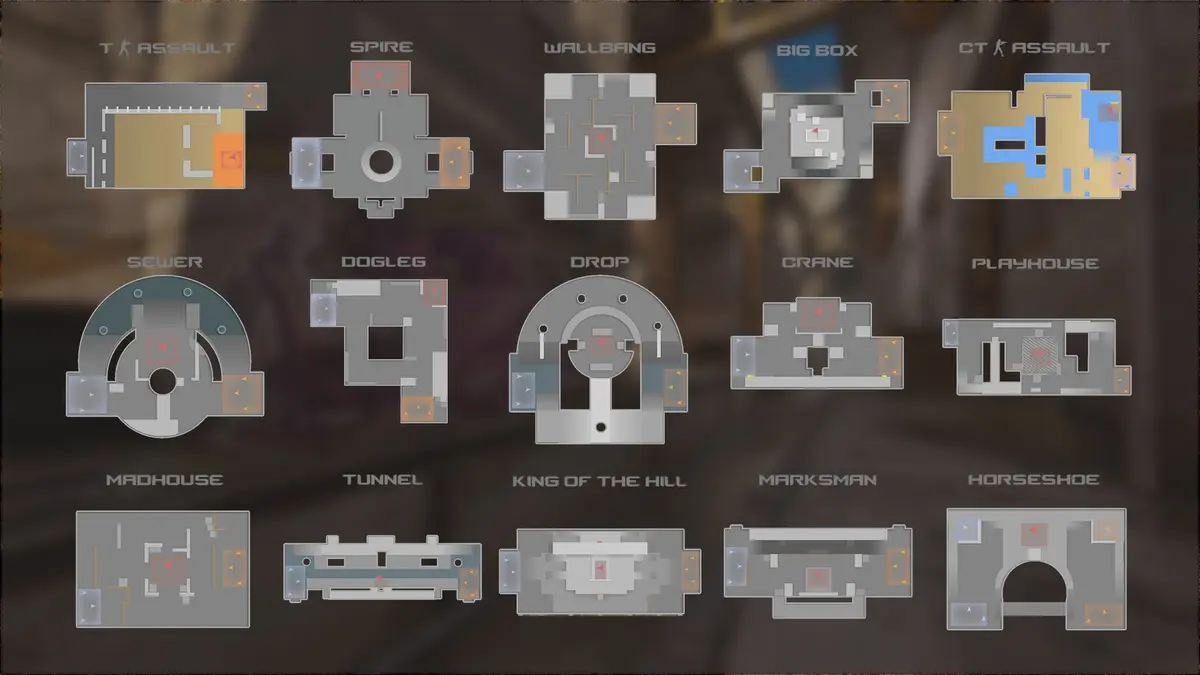
The arena pool is a set of compact, purpose-built plans rather than trimmed-down versions of the standard maps, and Valve has published the full layout graphic alongside the announcement. Names visible in it include Assault, Spire, Wallbang, Big Box, Sewer, Doglegs, Drop, Crane, Playhouse, Madhouse, Tunnel, King of the Hill, Marksman and Horseshoe.
Premier stops banning and starts picking
The change that will touch the most players is in Premier, where selecting a map has been turned from a veto into a vote. Rather than banning down to a single map, Team 1 picks one map, Team 2 picks two, Team 1 picks a fourth, and one of the four is then drawn at random for the match. Valve’s explanation is that players who spend time learning a map should have a chance to benefit from that investment.
It is a meaningful shift in how a competitive match is set up. Under the old system a team could win the map-selection phase by knowing what it wanted to avoid. Under the new one it has to name maps it is willing to play, knowing that two of its four choices can still be taken off the table by the draw.
The rest of the update
Beyond Rush and Premier, the patch adds a silent but slower reload when you hold the reload key, removes the sound of un-scoping a sniper rifle, and improves the visibility of blood and bullet-impact decals. Crosshairs are now resolution independent, with a new Crosshair/Scopes settings tab, new crosshair styles and a default that Valve calls Dynamic Quad. Clan tags tied to Steam Community Groups are back, stickers can be applied to the C4, and the engine has moved to the latest version of Source 2. Map fixes cover Ancient, Cache, Mirage and Train, the Zeus x27 can now damage chickens, and there is a new music kit, Starjunk 95’s Industrial Sunset Memories, sold in standard and StatTrak versions.
Our opinion
Valve has spent years sanding the edges off Counter-Strike 2, and this patch is unusual for doing two things at once: adding a mode nobody asked for and quietly fixing a competitive ritual that plenty of players quietly disliked. The Premier change is the more consequential of the two, because it rewards teams that can genuinely play four maps instead of the ones with the tidiest veto sheet. Scoring a random draw out of a four-map pool will annoy people who lose a series to the coin toss, but it is closer to how the game is played below the professional tier, where the goal is competence across the whole pool rather than mastery of one map. Rush, meanwhile, is a different bet: short, disposable rounds for players who want a match to fit inside a coffee break. Its fate depends entirely on whether the arena pool stays interesting after the twentieth time, and Valve has not said how often it will add new ones. The silent reload is the detail to watch. It is the kind of small mechanical change that shifts how aggressively players hold angles, and it will be argued about long after the novelty of a new mode has faded.