Reality Drift races through heaven and space to Steam on 11 November
Arganoid Industries has dated its roguelike racer for PC: 26 delivery missions, a card deck drawn at the start line and 99 rival cars that upgrade themselves as fast as you do.
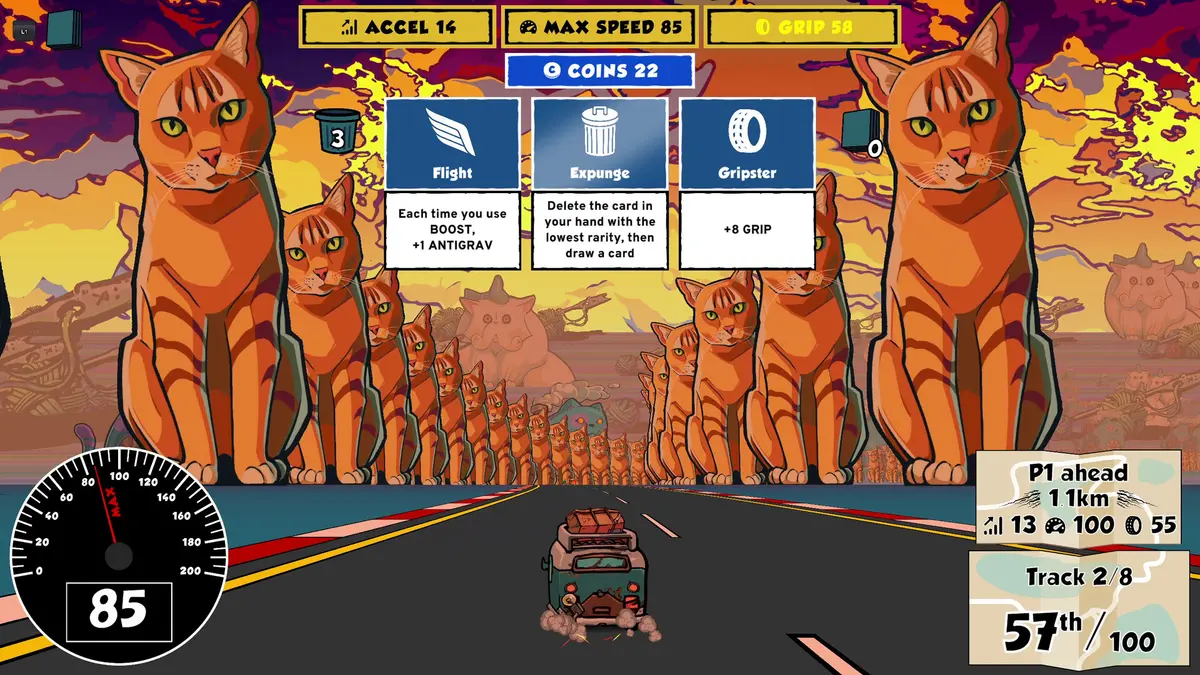
Racing games rarely ask you to think about a deck of cards while you are holding a line. Reality Drift does both, and Arganoid Industries has put a date on it: the roguelike racer arrives on PC through Steam on 11 November, with a Japanese release the following day because of the time difference.
Deliveries, disdainful gods and a card deck
The premise on the store page is package delivery through a series of strange worlds to godlike creatures with nothing but disdain for you. Races are strung across areas that include cities, seas, heaven and outer space, and at the end of each track you choose the next one from three options, weighing your car's statistics against the upgrades attached to each route.
Some missions fold in deckbuilding. Three cards are drawn at the start of a race and behave like passive skills, and entering a new area lets you keep one from another three. The core statistics are acceleration, top speed and grip, with power-ups including regen braking, boost, shield, antigrav and navigator, plus coins and a shop in some missions. There are 26 delivery missions unlocked by winning, each with its own twist, and a New Game+ tier once you have cleared them all.
The rival cars follow the same upgrade rules you do, and there are 99 of them in a race. That detail is what makes the structure more than decoration: if the field is getting faster alongside you, a grip build and an acceleration build stop being interchangeable choices somewhere around the tenth race, because the courses you pick decide which one the track will punish.
What is confirmed, and what is not
Steam lists 11 November for the United Kingdom with full controller support and full Japanese language support, and there is no price on the store page yet. AUTOMATON reports that some of the course designs were handled by Keita Takahashi, the creator of Katamari Damacy; that detail comes from the developer through the outlet rather than from the store listing, so treat it as the studio's own framing for now.
Our opinion
Roguelike racing is a crowded shelf of games that bolt a run structure onto a handling model and hope the loop carries it. What is different here is that the choice is spatial: picking the next area is picking the next difficulty curve, and the shop, the cards and the statistics all hang off that decision. It is the same trick Slay the Spire pulled with a map, and it works because the player recognises the shape of the mistake afterwards. The uncertainty is polish, not concept. A 99-car field on a roguelike budget is exactly the sort of claim that either produces a genuinely frantic grid or a soup of identical rivals, and the store page sells speed and weirdness without showing either. Wait for the launch-week frame rates before committing, because the idea deserves better than a stutter.