Meta launches $1M VR Start competition for developers
Meta is offering $1 million in prizes for new or updated experiences built for Meta VR Glasses and Quest, with the eight-week competition open until 18 November 2026.
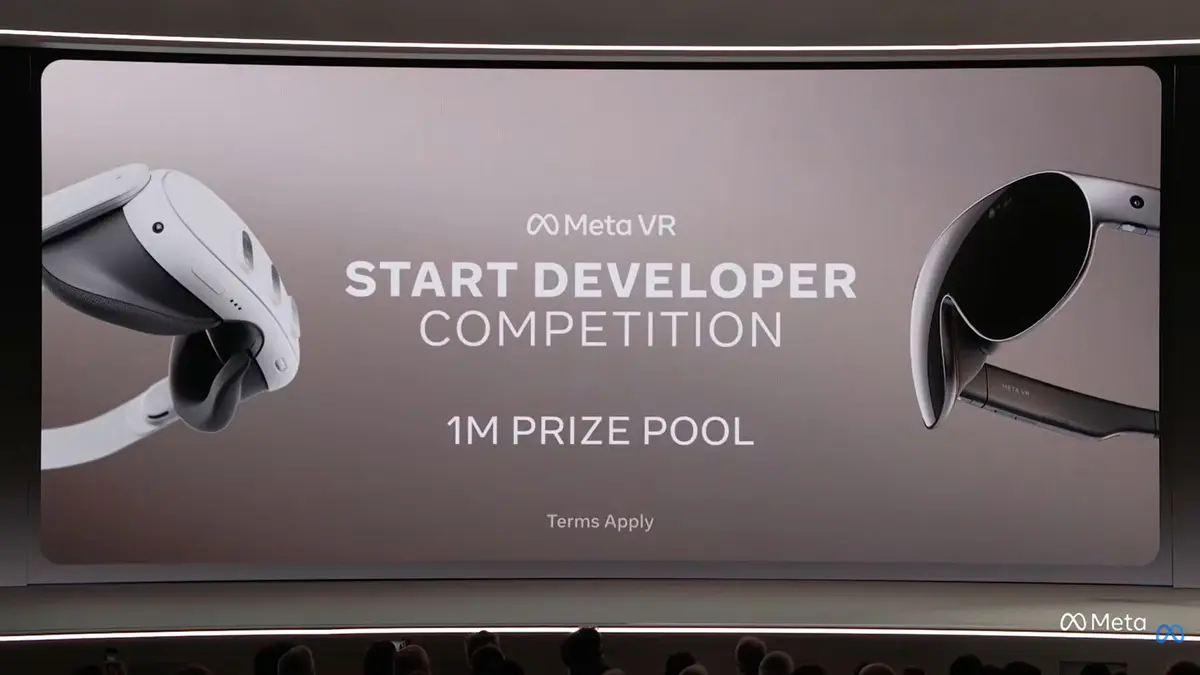
Meta has opened its second VR Start Developer Competition, offering a total prize pool of $1 million to developers building new experiences or significantly updating existing projects for Meta VR Glasses, Meta Quest or both.
The eight-week challenge began on 24 September and runs until 18 November 2026. It is open to members of Meta’s Start programme, with winners due to be announced on or around 11 December.
What's actually going on
Meta’s official developer announcement divides the competition into entertainment, gaming and productivity tracks. There are 20 cash prizes, ranging from $20,000 to $100,000, with a top prize of $100,000 available in each track. Meta also says winning projects will receive promotion through its developer blog, social channels and an end-of-competition livestream.
The competition is designed around Meta VR Glasses, the company’s next-generation headset scheduled to ship in spring 2027. Meta says the glasses run the same operating system as Quest, allowing developers to carry over existing engines, SDKs and workflows. Projects can be built with Unity, Unreal, a native engine, Android or the web.
Developers do not need to wait for the hardware. Meta says teams can build and test using Quest 3 as well as Meta XR Simulator, Meta Spatial Simulator and the Immersive Web Emulator. The rules also allow developers to submit an updated project rather than starting from scratch.
For gaming entries, Meta is looking for experiences that work well while seated and without controllers. Its examples include puzzle, strategy, casual, social and narrative games. Hand input must work from start to finish, although Touch controller support is allowed.
Why you should care
This is a practical attempt to solve the chicken-and-egg problem facing a new headset. Hardware can launch with impressive demonstrations, but developers need a reason to spend time designing around unfamiliar input methods before a large audience exists. A million-dollar prize pool gives smaller teams a tangible reason to experiment early.
The emphasis on hand-first, seated play is particularly revealing. Meta VR Glasses are being positioned differently from a conventional controller-led headset, so developers who understand low-friction interaction may have an advantage over studios that simply squeeze existing Quest games into a new form factor.
There is still a commercial question underneath the excitement. Promotion can help an independent team find an audience, but the competition does not establish how large that audience will be, how Meta VR Glasses will be priced beyond the announced $1,300 figure, or what the final launch catalogue will look like.
Our opinion
Meta is putting real money behind the most important part of a new platform: giving people something worth using. The competition’s strongest idea is not the headline prize but the focus on experiences designed around hands and seated play, because that encourages developers to think about what glasses are good at rather than treating them as a smaller Quest.
The caveat is that a contest cannot manufacture a market on its own. Meta VR Glasses will still need comfortable hardware, clear tools and a compelling reason for players to return. For developers already interested in spatial apps, though, the defined deadline, accessible testing routes and meaningful prizes make this a credible opportunity.